

The Pulsing Life of the Finished Work: An Interview with Stephanie Duncan Smith
The gifts of releasing the work, editing as time travel, and working on the new Rachel Held Evans collection


Dear Friend,
I love hearing from brilliant people about their relationship with language; what it means to them, how it shapes their lives and creativity.
So, on occasion, I interview someone and share it here.
This interview is a delight in part because of the far reaching impact of Stephanie Duncan Smith’s editing work in my own life. She’s touched most of the publications that influenced me as a young adult and edited many projects that have influenced me in the time since, including, as you will hear, the recent posthumous collection by Rachel Held Evans. Getting to hear about her thinking and process was a true delight.
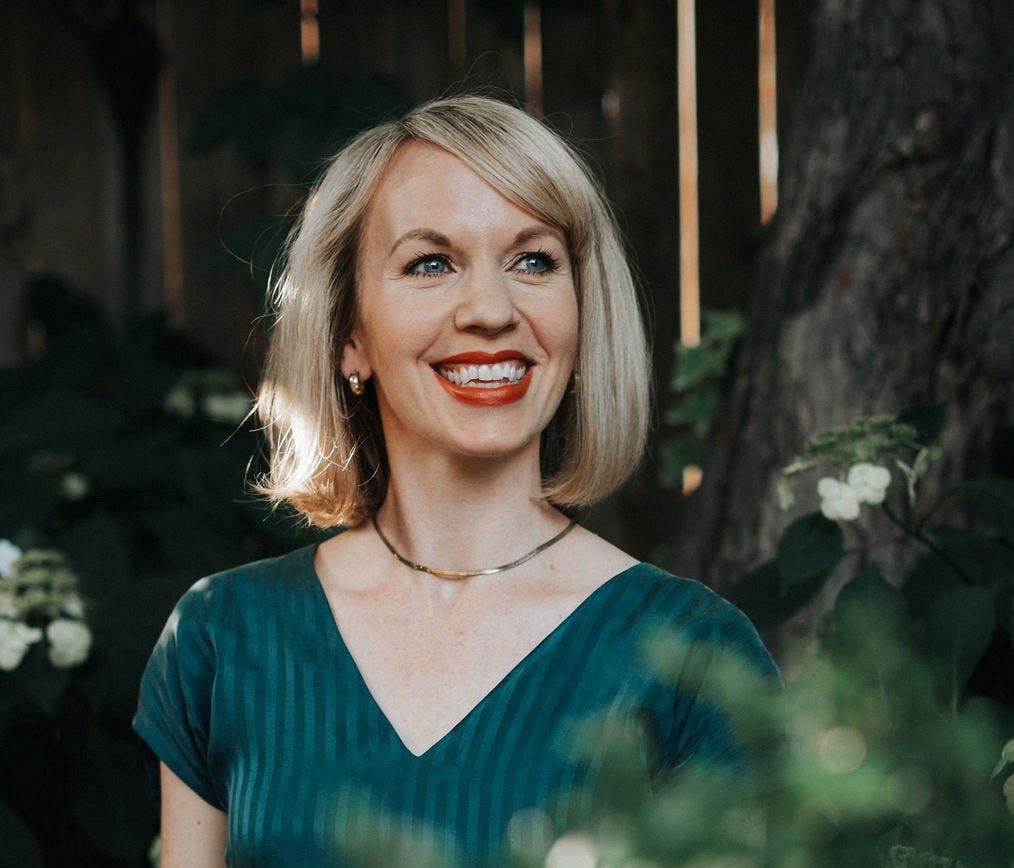
Stephanie Duncan Smith is a senior editor for HarperOne who has spent her career developing award-winning and bestselling authors. She is the author of Even After Everything: The Spiritual Practice of Knowing the Risks and Loving Anyway (Convergent Books, Oct 15, 2024) and the creator of Slant Letter, a bestselling Substack email newsletter for writers who want to deepen their craft and do it in style.
Stephanie completed her master’s in theology from Western Theology Seminary, where she was the two-time winner of the Frederick Buechner Excellence in Writing award. She was also nominated for the Publishers Weekly Star Watch program recognizing “the rising stars of our industry.”
In all her work, she believes that language is wild and alive, and the writing process can be a profound spiritual practice.
Stephanie lives with her husband, Zach, and their two children in Pennsylvania’s capital city. You can find her on Instagram at @stephduncansmith.
Dana: I like to start these conversations by asking about a text that has been supporting you right now.
Stephanie: I picked up this book, The Release: Creativity and Freedom after the Writing is Done by Elizabeth Jarrett Andrew, and it’s this gorgeous cover. She has some really beautiful things to say about releasing your creative work in the context of what’s kind of bubbling up in the larger conversation about the gift economy.
“The life force pulsing within completed work is more influential than we assume, and can move into ever wider spheres, regardless of publication.”
Andrew also has a chapter called How Does the Gift Move? and this is about when a creative work is complete and you share it; it’s outside of your hands. It’s moving into a life of its own. She says...
“From this dance of receptivity and creativity arises the fullness of our humanity. To be is to become. So aliveness in our art is synonymous with its movement…The gift stays a gift so long as it moves. When a completed work quickens our own end or others hearts, when it travels from our hearts into hands, speech, relationships, and community, it is released.”
And I love that because I think it can be really, really hard for writers to release in general, whether that’s publication of any kind, making a post go live, or a newsletter, or a book, or handing over some draft pages to an early reader, whatever the form of that. It can be really hard to let it go because we really like to be hands-on with our work. But it’s very helpful and very beautiful the way she speaks of this gift.
And of course, you want to give a gift, that’s the whole point of a gift; reframing the completion of work from a loss into something generative. Because there is a sense of loss! I work with some writers who are really terrified of the moment when their manuscript goes to the printer because that for them signals the point of no return. They can’t touch it anymore and that is a felt loss. But when we consider the work something that keeps moving out from us, going from my desk to a reader’s hands to their friend. And that’s a real liveliness of creativity in that movement.
Dana: The phrase that stood out to me was the pulsing life of the finished work. Because it is alive and distinct and that life needs to go somewhere. That’s so interesting. To think about the labor, not just being in the making, but the caretaking of the work beyond yourself.
Stephanie: Yes, and I really like that reframe, too, because it’s that’s “live pulse” as opposed to, let’s say, a book that’s gone to the printer and is produced into a physical artifact. For the writer, your process is so alive and you feel the pulse of it then and then you’re handing, you’re holding a book in your hand and you’re like, “Oh…this is it. It’s an artifact. It’s done.”
But no! The book is only just beginning in the life of the reader.
Dana: You are with other writers all the time as they go through that transition of being with the liveness of what they’re making into the liveness of a readership. And it seems to me like an editor kind of stands in both space because you are reading as a present reader AND a future reader while in conversation with the present writer. So I think I’m asking: are you a time traveler?!
Stephanie: I suppose the only honest answer is yes. Usually how I describe it is my role as an editor is, I am your 1st reader, and my job is to stand in for your reader and mirror back to you, the writer. How I best anticipate your words will be greeted by your reader. And since we’re still in the editing stage, If I’m mirroring back something that does not match your intent, you can change it—here’s what is great / confusing / off-putting / ambiguous. I am future-forecasting for the reader’s experience and bringing that back into the real time to make the changes, to engage the reader exactly the way the author hopes and intends. I don’t always get it right but it’s fun.
Dana: You’ve written on the internet a long time. You’ve had a substack for a long time. You have written a book. What has your experience been with that process of release, of seeing your text go from a life with you to the life of a reader?
Stephanie: It’s been truly incredibly rewarding. I really did not even imagine the responses I would get to the book as I wrote it. Beyond my expectations. Such a gift. And very deeply meaningful to know that readers experienced it the way I hoped.
Because I’m an editor, I have the advantage of publishing experience even as a first-time author. In the flow of the publishing timeline, there’s a pretty good-sized dead zone between when the manuscript is complete and locked from any further edits and when any advanced readers start reading your book. It’s several months. And that zone can feel really antsy for writers because then they often start second guessing.
So I had that experience going into my own process and I was able to navigate that and be supported in that. I had confidence that I had done everything that I could do for this book by the time that I handed it off to the printer. And I also knew from editorial experience that often once it gets close to the printer stage, sometimes writers want to make a lot of changes, but it’s not making it better—it’s simply rearranging the furniture. I tried to spare myself that. And we could rearrange the furniture forever. I don’t regret anything in my book, but would I keep tinkering even now? Absolutely. And that’s fine. That’s not a problem. But that feeling doesn’t mean there is actually anything that needs to change in the book. There is a natural point of completion and it takes a lot to trust that.
Dana: It sounds like your experience of readers has been an experience of that “gift economy”, hearing about your book’s new life. You said “beyond your expectations.”
Stephanie: Yes. It’s such a counterintuitive process because the writer is spending untold hours creating this thing in isolation. And then once it gets released—in every sense of that word— it enters into a live conversation. And it becomes this thing that brings people together. And I really do see any book as a conversation between writer and reader. And what’s fascinating to me about that is that that conversation is unrepeatable because every reader is different, making the conversations infinite. Every reader brings their own set of lived experiences and perspectives to a work. It’s a very intimate thing to read a book and be in that conversation with a writer. And what an honor to get to do that! Even if a reader doesn’t enjoy it, that’s okay!
Dana: So a book becomes a conversation that expands beyond the reader and the writer, to one between the reader and another reader. It’s a whole constellation. In your online writing life, how do you see that conversation, the gift economy playing out?
Stephanie: What’s fun about online writing is how real time it can be. A book is a place to go deep. But online, that’s a place to tune into the conversation that’s happening live, right now, today. And that won’t keep for a book, you know? So there’s a place for everything.
We talk about this in publishing. My editorial team sometimes will get a proposal and we’ll think, This is fantastic. But it feels more like an article, not a book. It feels like it should come out today and be this big splashy piece that everybody talks about, but I don’t know that this is a book that people will want a year and a half from now.
And also, I mean, for me, something that’s been really freeing about writing, particularly on substack, is that I don’t have to be a perfectionist about it. It’s a good practice to be like, You know what? Here we go. I’m going to proof it. I’m going to edit it, but I’m not going to belabor it. I excel at belaboring. But substack doesn’t need to be print-perfect. Nothing is getting memorialized forever. Let it be what it is for today, this week.
Dana: I worked with a developmental editor who was helping me sort out my own writing process. And she said “Your substack is just proof of thought.” I had thoughts and I am demonstrating that I had them.
Stephanie: I love that.
Dana: The thing that I appreciated when I first came to your newsletter was how clear and understandable the stated purpose is. There are other publications out here about the process and logistics and mechanics of publishing. And they’re wonderful and they’re there. But your work is about the spirituality and creativity of the writing. Which I might say is the ineffable, hard to articulate relationships we have with the things we’re making and the people who are reading them. How did you come to that definition?
Stephanie: A phrase that I say a lot, and you’ll see it in Slant Letter, “As in as in writing, as in life.” Or as in writing, as in life, as in faith. (And I could add, as in parenting!). It’s all cut from the same cloth. The process itself is the spiritual practice, and we become who we’re meant to be—we become more human. We become more of our authentic selves through the stretching that happens in the process, whether that’s the writing process, or the life process or the faith process or the parenting process. There’s no hacks; there’s no shortcuts. There’s only engaging what’s right in front of you while finding an honest way through and staying with yourself. And all of those things are hard and all of those things stretch us. And they can form us in really profound ways. And at the end of that process, if we stick it through, I think we find we’re also proud of ourselves. And that’s rewarding.
And, you know, just to pick, cherry pick one example, but ask any writer: the real reward is not not something magical that happens when you hold the book in your hand or how many books you sell. Those are all great, but the real reward is just having written the book. You did it! And that is such a high. You had to get through a lot to get there.
You know, everybody’s looking for the hacks and I’m just convinced there’s no hacks. It’s only finding the next step in front of you an, taking it authentically. The only way you can write a book is literally stringing a book together word-by-word and being like, okay, what’s my next word? That’s the only way it can get done. And we live our lives one day and one hour at a time. That’s all we’ve got. So there’s no hacks. Might as well make it a spiritual practice and feel good about it!
Dana: Bit of a tangent. Jack at Little Amps just released an album. So I bought it and sent him a little note that said, “making stuff for the hell of it is at least half the point of being alive.”
Stephanie: So good.
Dana: And he said he hoped I liked it and I was like, “I hope I do too, but also if I don’t, it doesn’t matter! I’m just excited for you, this person, I see all the time to have made something that you felt like making, and that in itself, I’m thrilled about. Yes. Like, I don’t have to like your music to be excited, that you make music.
Stephanie: I love the way you put it, and I’m such a big believer in me, as you said, making things for the hell of it. Don’t do it because somebody expects you to do it. Don’t do it because you might make money.
In the thick of life demands right now, I don’t have a robust writing process, practice. I’m doing Slant Letter and like I have my work with my authors, but I’m not sitting down for extended periods of time and working on my craft.
What I am doing is keeping a five-year journal. It’s five years in rows across the page so you can look back and watch your tracks. Not a lot of room so it’s just little sketches of the day. And I know that I want to be able to look back, but also, I need it today because I need to witness myself in my life right now. I need to express my experience. And in two to three sentences, I’m saved.
It really does something for my body to let the words physically move through my brain and nervous system through my arm onto the page. That is so good for me. I haven’t run any tests, but I’m pretty sure that my nervous system is regulating in that practice in those three minutes and three sentences. It’s not for any purpose except just paying attention to my life. And it’s such a good anchor. We all deserve that.
Dana: One of the things that has been remarkable to me about meeting you is realizing how you have been in so many editing and publishing spaces that have touched things I’ve read or been influenced by over the course of my young adulthood into the present. When did you start to understand that language was not just part of life, but was a job you could do?
Stephanie: Benevolent nudges. My mom was very pragmatic about career prospects; I liked writing in school and she pointed me towards journalism. I’ve always been a reader. Reading was like very much part of my family culture growing up. I majored in communications because I loved reading and writing. Like most comms majors, I had no idea what shape that would take. But one professor was like, “You know there’s a publishing house across the street, right? You should go get an internship there.”
I graduated right in the height of the recession. But I was able to work as a contractor for the publisher to bridge me over until my frist in-house editorial job. I’m very grateful for that. And I’ve stayed in publishing.
Dana: A recent editing project of yours just hit the NYT bestseller list: Braving the Truth: Essential Essays for Reckoning With and Reimagining Faith by Rachel Held Evans. Congratulations! This is also special for us on a personal level because of who Rachel Held Evans was to us. Everyday, in whatever happens, I wish Rachel were here with her words and her courage to show us the way. What was it like working on her posthumous collection?
Stephanie: This was obviously not a book that anyone planned on or wanted; we want Rachel to be alive and with us. I was paired with this project in part because of my familiarity with Rachel both as a reader, a person, and editor for some of her articles over the years.
Sarah Bessey took on the immense work of curating the collection; Rachel was just so prolific. Sarah did the incredible work of not just making the selections, but composing them into really a full, narrative arc. And she was very intentional about choosing not just the viral pieces but the moments where Rachel is writing about her personal life and about what it’s like to become a mom and breastfeeding and what it’s like to live in her small town and be ostracized for her beliefs.
I had to take emotional breaks while editing. I was just struck so many times by the dual reading experience of remembering where I was when I first read these pieces years ago. But I was struck so many times how timely and fresh her writing back then is for our moment right now. And I feel very strongly about that.
So it’s a work of preservation but it also reverberates in ways that are really remarkable. She gives us wisdom to carry with us into the future. It’s remembering her in our moment today. As you said, there’s so many who wish that her words could speak for us, wish that she were here to find the words that we’re looking for right now. It’s a beautiful book. And I think the title says it all: we need to be brave.
Dana: I want to be as brave as she was.
Stephanie: She didn’t play by anybody else’s rules. She just didn’t play the game. I remember being at a writing conference with her that was hosted at a seminary. So it’s all these, you know, seminarians and future scholars and they’re deep in the academy. And when she gave her address, she was very pointed in her own decision that she would not be seeking further higher education for herself. And at the time, I sort of chuckled and was like, “Read the room, Rachel!” But she did not care. She was speaking for herself and she was like, “I don’t need to be validated by the establishment. I’ve done my research.” And to be clear, she’d done more research than most people. I don’t know that I’ve ever known a writer who would read as much as she would before writing. Scholars would consult with her! So she was very, very secure in her choice to say, “I have what I need. Thanks very much.” And that kind of boldness and that kind of confidence really just set her apart. And I think it gave permission for other people to do the same.
interview finis
This is perhaps a strange moment to end an interview.
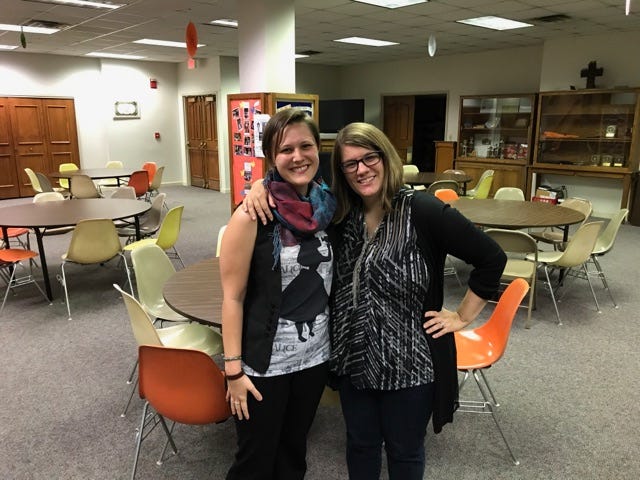
In real life, Stephanie and I kept talking about what Rachel meant to us. We shared stories of meeting her, stories of grieving her. But ending here circles us back to the beginning where Stephanie shared the quote about the “pulsing life of the finished work.” Rachel’s work is still alive in us. And that is a true thing we shared at my table. Her work is in our bodies; it moves us to tears; it moves us to imagine present and future selves in our lives who are brave and strong; and it connects us to each other.
Rachel didn’t hold onto her work; she gave it freely and at great cost to herself. And the gift continues.
 | A guest post by
|